Section 01Notice to recipients
This document is a confidential positioning and information memorandum for the OPAL™ protonic computing programme. It is prepared by VivoVac Pty Ltd for directors, advisers and qualified counterparties. It is not a prospectus, product disclosure statement, or an offer, invitation or recommendation to subscribe for securities in any Group entity under the Corporations Act 2001 (Cth) or the US Securities Act of 1933.
- Content is conceptual. Unless a signed contract says otherwise, nothing here is a specification, datasheet, performance guarantee or offer to sell a finished product.
- Compute statements on the OPALBLACK ledger are conditional on experiments that have not been run. A negative species result (E1) means no computing claim is made.
- Third-party figures (IEA, Rystad, LBNL, TrendForce) are public and dated. They are not the Group’s measurements of an OPAL device.
- A disclaimer does not cure a statement that is misleading or that lacks reasonable grounds. Read Section 16 in full before relying on anything.
Section 02Executive summary
We are building a five-channel protonic computer that works with silicon. Silicon stays for speed. OPAL is intended for cheap, persistent, long-timescale learning — memory and compute in the same oxide — so that layer no longer has to buy a leading-edge GPU, a 120 kW rack, or a cooling tower.
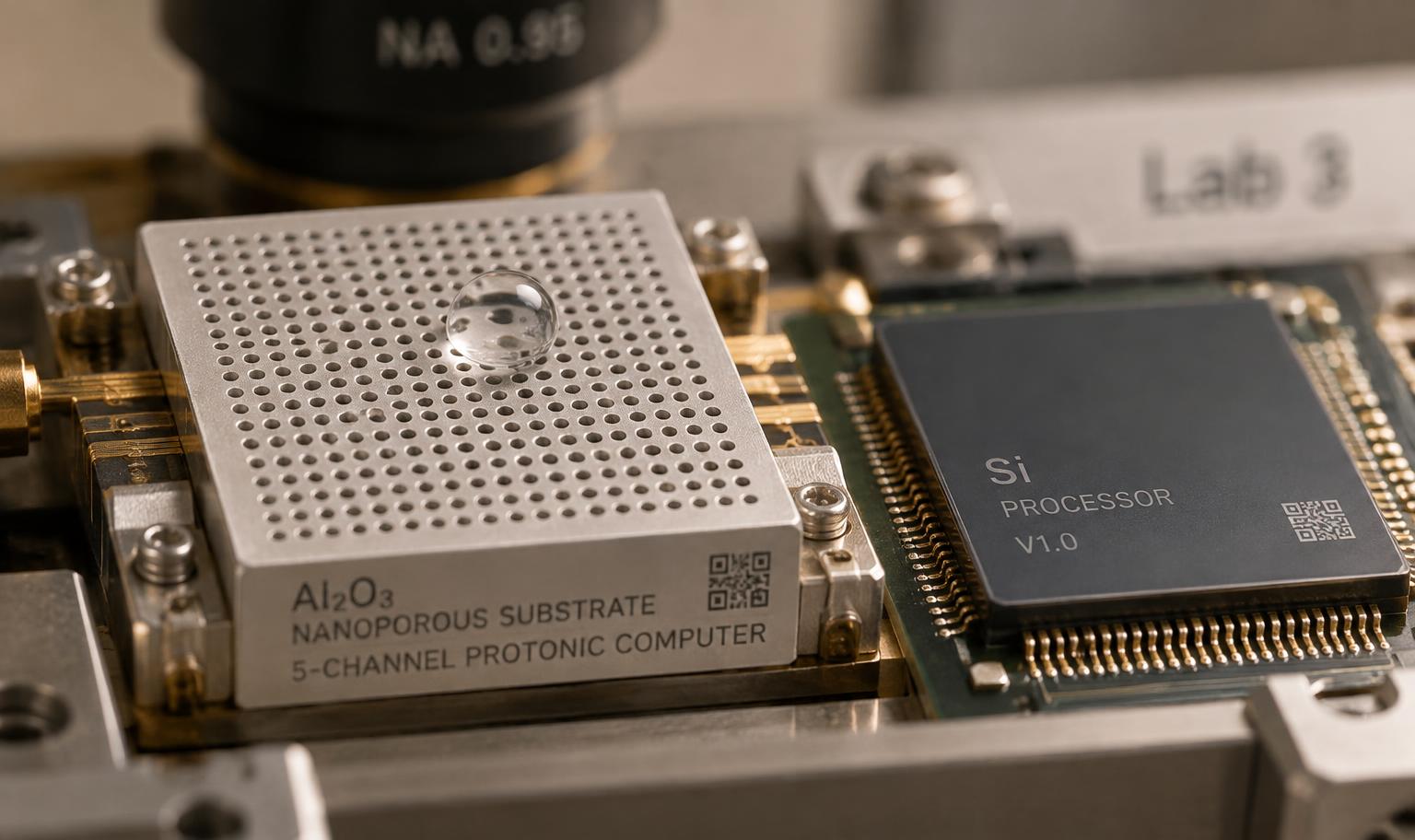
OPAL™ (Oxide-Mediated Protonic Analogue Logic) is a proposed third computing substrate. After electrons and photons: protons. The working material, OPALBLACK, is nanoporous anodic aluminium oxide, grown in a bath rather than printed in a fab, and read electrically. The manufacturing route does not compete for a 2 nm wafer slot, a CoWoS package or an HBM allocation.
Section 03The problem
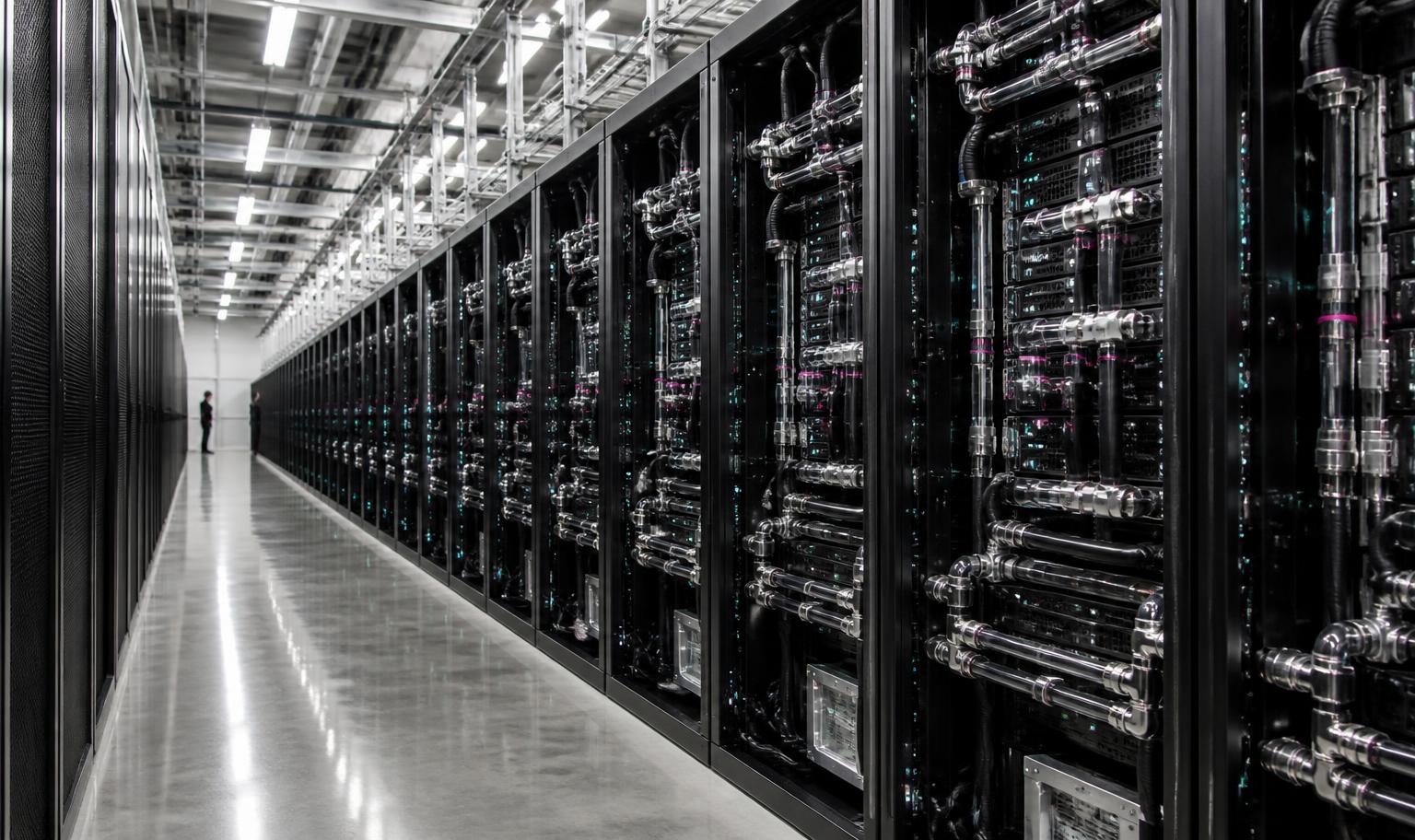
Intelligence is being rationed by three meters: chips, watts and water. The AI era does not flatten this curve. It steepens it.
$30,000
Reported analyst estimate per 2 nm wafer, against roughly $18,000–22,000 for 3 nm. TSMC does not disclose list prices.
TrendForce / Silicon Analysts, 2025–26
2028
How far 2 nm capacity is reported booked. Access is allocated to lead customers, not purchased on an open market.
Supply commentary, public
945 TWh
Projected data-centre electricity in 2030, from 415 TWh in 2024 — slightly more than Japan consumes today.
IEA, Energy and AI, 2025 base case
222 bn L
Direct cooling water in 2025, heading for 644 billion litres by 2030 without efficiency gains.
Rystad Energy, 2026
About half of US electricity demand growth to 2030 comes from data centres. Unlike electric vehicles, data centres cluster, so the binding problem is grid integration in specific places. Direct cooling water is large. The larger figure almost nobody counts is indirect water at the power station — about 1.2 gallons per kilowatt-hour on a thermal grid (LBNL 2023). A watt not spent is paid twice where the grid is thermal.
Section 04What we are building
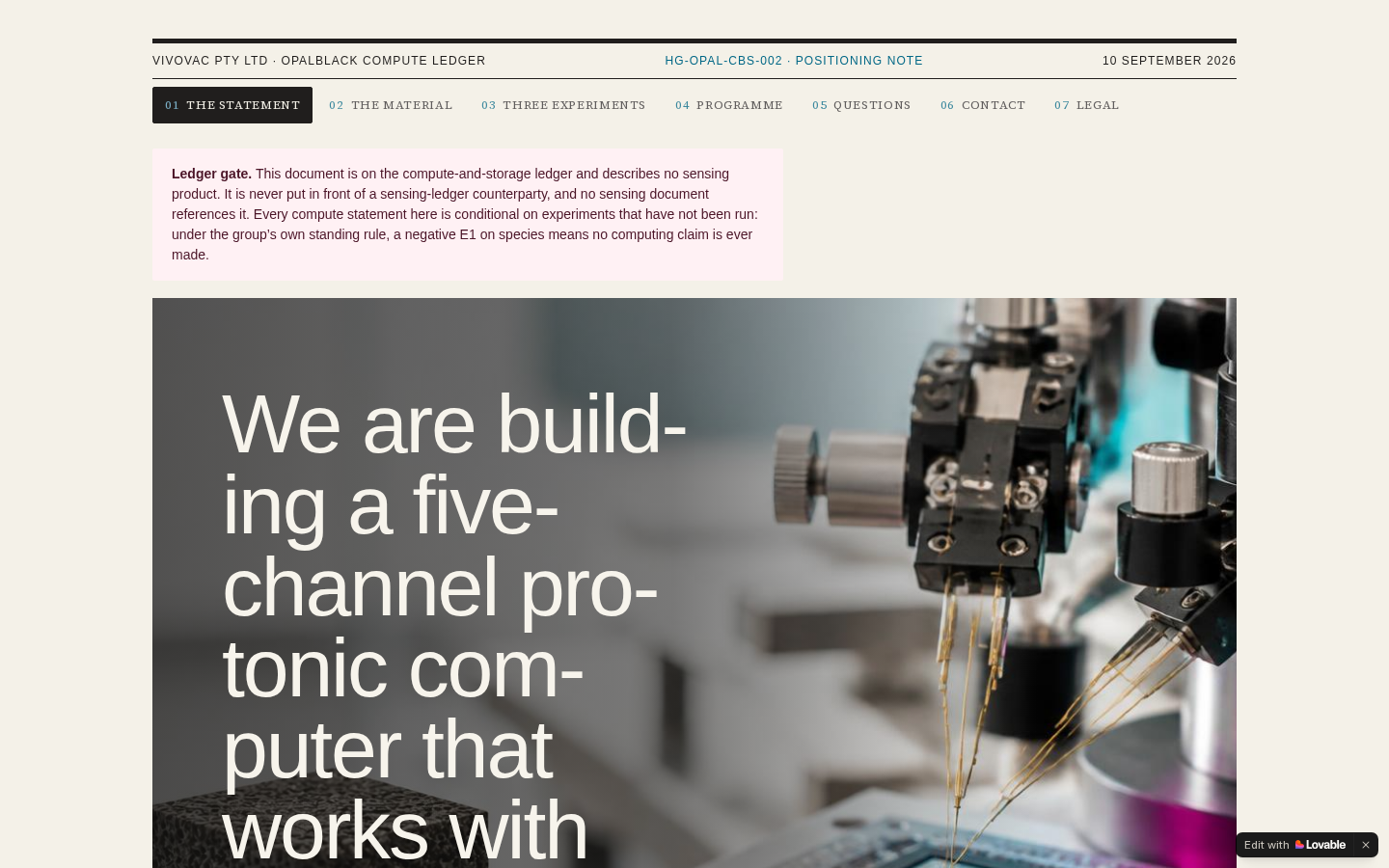
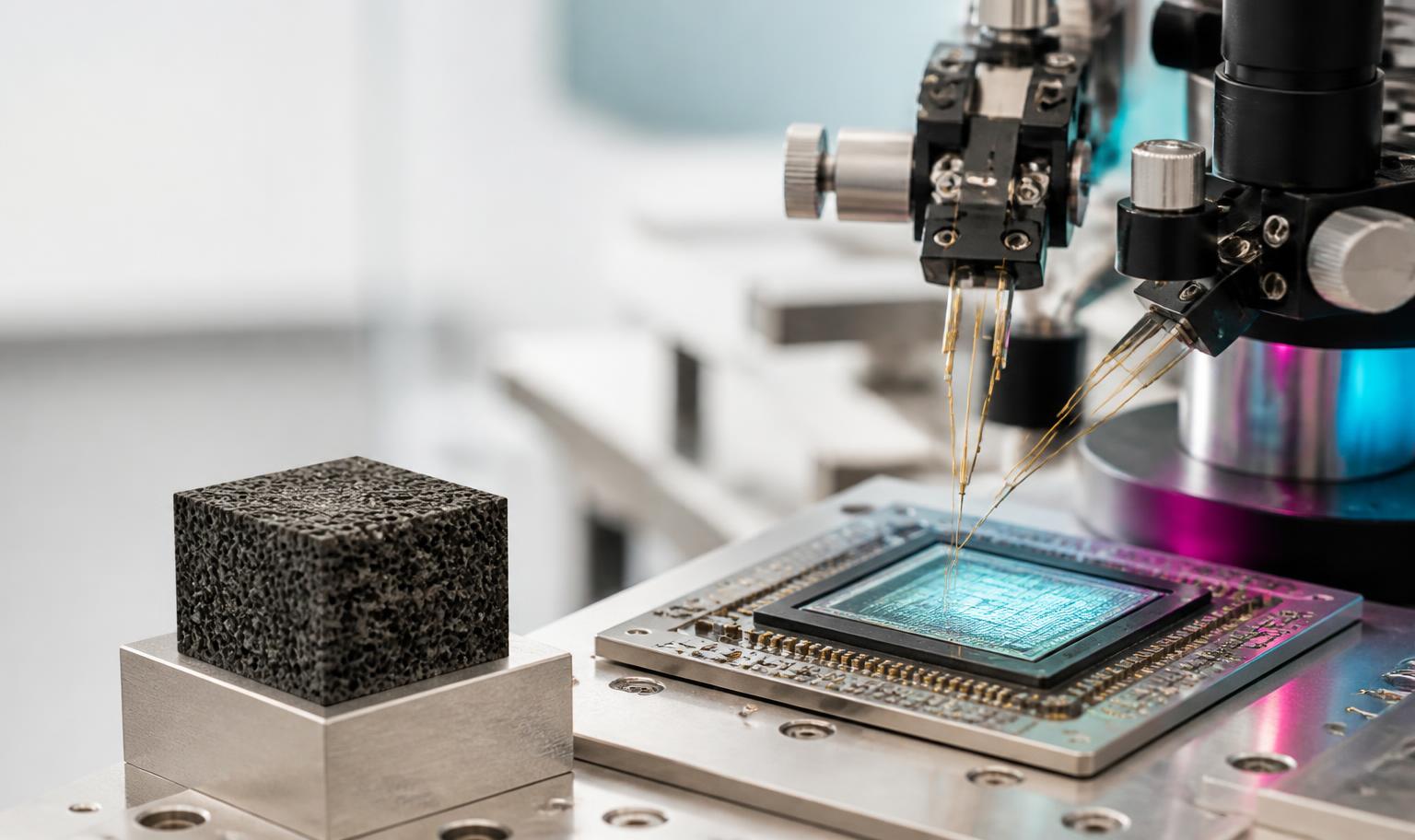
A protonic oxide layer, made from aluminium and water, that sits beside a silicon processor. Silicon handles high-speed digital processing. The protonic layer is for low-cost, persistent, analogue, long-timescale learning — memory and compute in the same film, without a separate RAM bus.
Keep silicon for
- Logic, arithmetic and control
- The memory hierarchy the industry already has
- Everything that needs a foundry’s precision
- The processor a protonic layer still sits beside
Pair protons for
- Holding analogue weights a short distance from the die
- Work that should not join the wafer queue
- A bath process on a seventy-year equipment base
- One narrow job, done well, next to the chip
We do not dump silicon. We do not claim it is running out. We pair it with a proton-transport medium so that some of the work that currently competes for a 2 nm slot, a CoWoS slot and an HBM allocation can be done on an oxide grown in a bath.
Section 05OPALBLACK material
OPALBLACK is nanoporous anodic aluminium oxide, engineered as a proton-transport medium and read electrically.
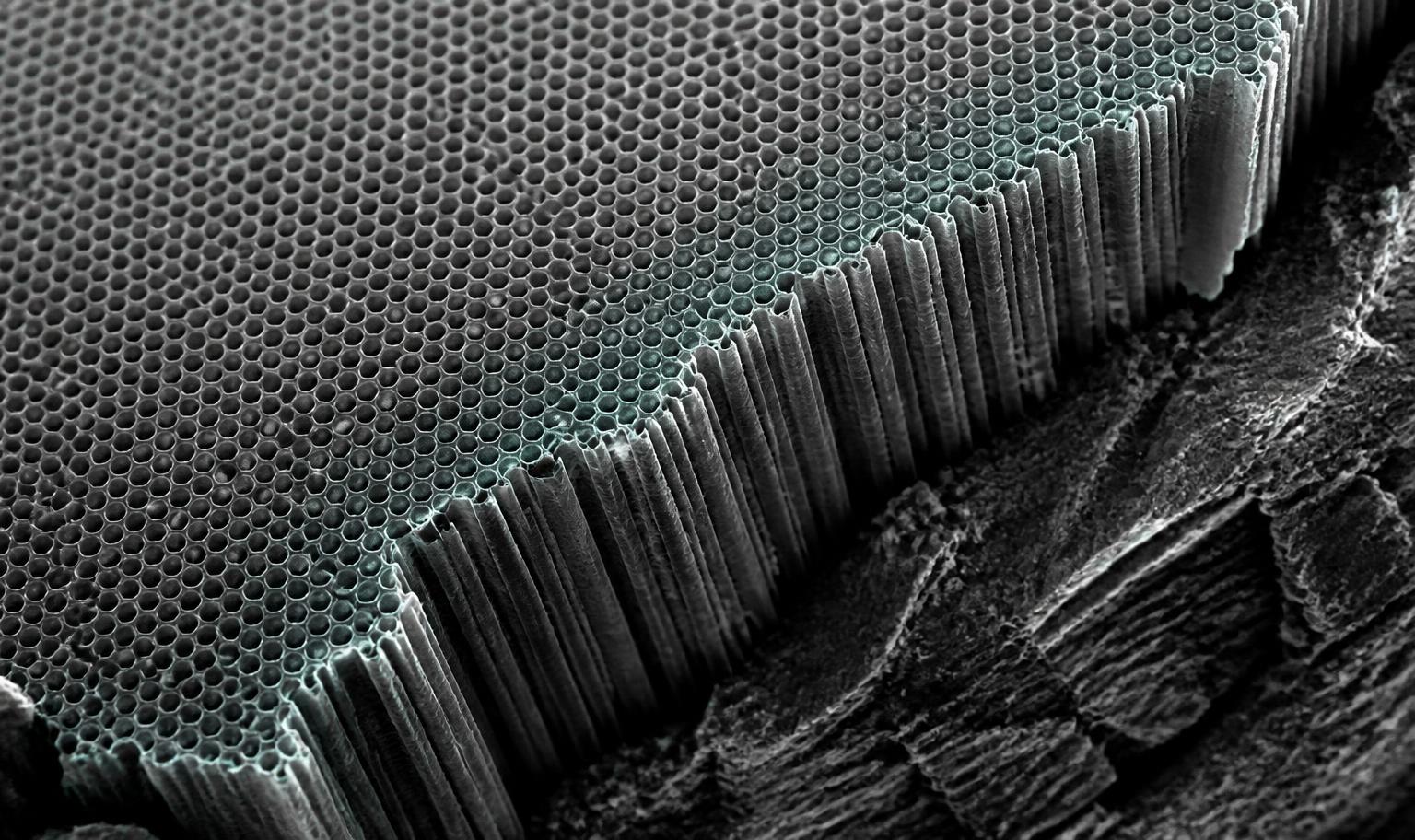
The material is seventy years old. Anodising grows a controlled porous oxide skin on aluminium by passing current through it in a bath. It is done at industrial scale, everywhere, today. Nothing about making the layer is exotic, and nothing about it requires a fab.
What is engineered is the pore structure. Pore geometry, sealing state and zonal definition across one part — so that different regions of the same oxide carry different function. That arrangement is what the Group has filed on. Filed, not granted, and not searched by an authority.
The carrier is a proton, not an electron. In porous anodic alumina, conduction runs by electron tunnelling when dry and protonically when humid. Settled physics, published in 1984 (Nahar, Khanna & Khokle). It is not the Group’s discovery and is never presented as one.
The same oxide, read at two depths. Read shallow, it reports what a surface has been exposed to — a different ledger, never sold to the same buyer. Read deep, it is a candidate for holding and modulating analogue state.
Section 06Five channels
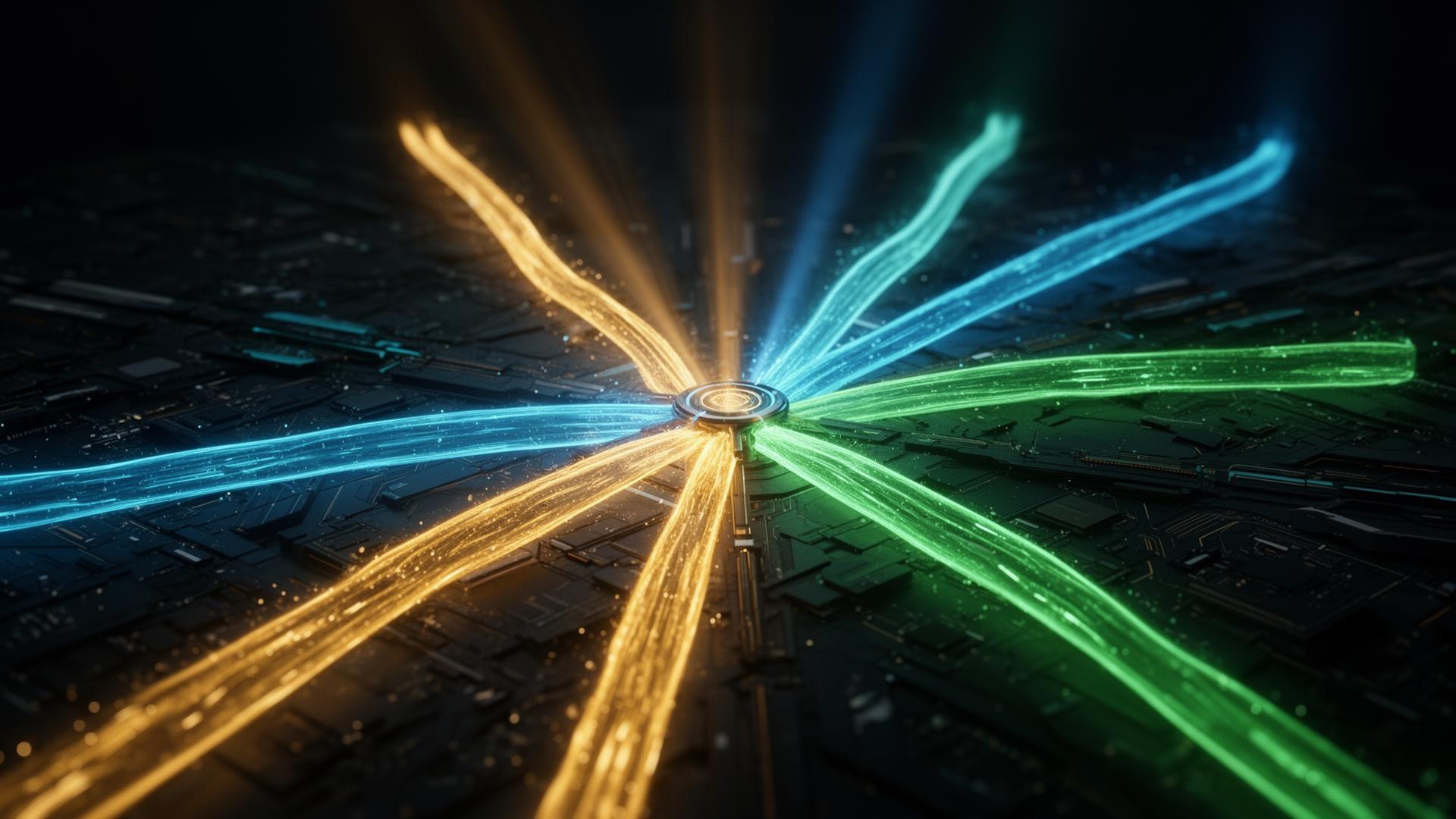
Public architecture on protonicopal.com describes five simultaneous physical channels in an Al / Al₂O₃ stack. This is the Group’s architectural filing position. Channel-level performance has not been demonstrated as a commercial computer.
| Ch | Name | Stated function |
|---|---|---|
| CH1 | Proton flux | Primary information carrier. H⁺ transport via Grotthuss hopping. Analogue variable-weight logic. |
| CH2 | Impedance modulation | Memory and compute in the same oxide layer — the stated attack on the von Neumann bus. |
| CH3 | Thermal gradient | Heat from the aluminium–water chemistry; public site claims energy harvesting at node level. |
| CH4 | Acoustic emission | A parallel physical channel; timescales distinct from proton flux. |
| CH5 | Electrochemical potential | Zonal electrochemical state across the same part. |
Public site also cites patent-protected clock recovery (AU 2026902999, AU 2026903000) to synchronise channels that run on different timescales. Those numbers are provisional filings, not granted patents.

Section 07Why pair, not replace
- Silicon logic is not the bottleneck. Moving weights is. Published protonic work targets analogue deep learning — programmable resistors as synaptic weights — not CPUs.
- The manufacturing route is the advantage. Anodising does not compete for wafer, CoWoS or HBM slots.
- Replacement has a certification clock measured in decades. Pairing inherits far less of silicon’s qualification burden.
- The energy argument only works at the margin, and the margin is enough. Data centres reach about 3% of global electricity by 2030. We use the concentration framing, never a planetary one.
The most advanced published protonic compute result (Onen et al., 2022, MIT / MIT-IBM Watson AI Lab) was engineered to be compatible with silicon, not to displace it: nanosecond protonic programmable resistors, 20× dynamic range, CMOS-native materials, for analogue deep learning. The pairing thesis is where the field already is.
Section 08The one-percent arithmetic
Not a revolution. One percent of the IEA 2030 data-centre load — the smallest number still worth the arithmetic. A device class that carries one narrow job only needs to be good at that job. The tariff below is a working assumption, not a sourced figure.
9.45 TWh
Electricity a year unspent if 1% of the 2030 IEA base case moves off the thermal path.
945 TWh × 1.00%
~43 bn L
Water left at the power station at 1.2 gal/kWh (US thermal average).
Derived from LBNL intensity
US$ 756 m
Illustrative annual electricity at US$0.08/kWh. Modelled — stated assumption.
Group working, not a forecast
6.7 ×
More water saved than taking the same 1% off direct cooling (~6.4 bn L).
Derived
Working: 945 TWh × 1.00% = 9.45 TWh. At 1.20 gal/kWh: 9.45 × 10⁹ kWh × 1.20 = 11.3 billion gallons ≈ 43 bn L. Direct cooling: 644 bn L × 1% ≈ 6.4 bn L. At 15% annual sector growth, 9.45 TWh is replaced in about twenty-four days. That is why efficiency has to come from a structurally different device, and why the manufacturing route matters as much as the physics. If E1 fails, the addressable share is zero and this claim collapses to the arithmetic alone.
Section 09Scientific lineage
Protonic computing is not a new idea, and that is the point. A proposal that needs new physics needs a miracle. This one does not. None of the rows below is the Group’s work.
1984
Protonic conduction in porous anodic alumina. Nahar, Khanna & Khokle, J. Phys. D 17, 2087. Anions from anodising act as proton donors.
1997–2004
Proton transport becomes measurable. H/D isotope effects; hydrogen isotope sensors on proton-conducting oxides.
2011
First solid-state protonic transistor (Rolandi, University of Washington). Proton mobility ~4.9×10⁻³ cm² V⁻¹ s⁻¹. IEEE Spectrum: first solid-state transistor to control protons.
2014
Reflectin protonic transistors ~7.3×10⁻³ cm² V⁻¹ s⁻¹, on/off ~1.6. Honest ceiling: slow and poorly switching at that geometry.
2022
Onen et al., MIT / MIT-IBM. Nanosecond protonic programmable resistors in Science. Room temperature, nanoscale channel, 20× dynamic range, silicon-compatible, for analogue deep learning.
Section 10Proven, claimed, not claimed
Three registers, kept separate on purpose. A claim without a stated falsifier is a slogan.
Already proven · Physics
Porous anodic alumina conducts protonically when humid, by a mechanism settled in 1984.
Falsifier: Not ours to falsify — the field’s result.
Already proven · Process
Anodising grows controlled porous oxide at industrial scale, on seventy-year-old equipment, with no fab.
Falsifier: Visit any anodising line.
Already proven · Demand
Data-centre electricity demand roughly doubles to ~945 TWh by 2030 on the IEA central scenario.
Falsifier: If the IEA revises, every TWh figure here falls in proportion.
What we claim · Hypothesis
The same oxide, read deep, is a candidate for holding and modulating analogue state.
Falsifier: E1: if species identification comes back negative, no computing claim is ever made — this row is deleted, not softened.
What we claim · Position
Pairing — not replacing — is the correct posture toward silicon.
Falsifier: If a protonic device ever beats silicon at logic, this row was still right when written.
What is not claimed
We do not claim silicon is running out; a granted patent; an authority search; or a working commercial device.
Falsifier: Filed, not granted. Three experiments stand between hypothesis and answer. They have not been run.
Section 11Intellectual property & corporate
| Issuer | VivoVac Pty Ltd (ACN 652 414 376) |
|---|---|
| Related | HydroGien Pty Ltd |
| IP vesting | OPAL™ and GALVANOXIDE™ trademarks. All IP exclusively vested in the HydroGien / VivoVac group, as stated on protonicopal.com. |
| Status | Patent pending: 70+ Australian provisional applications (public site). Filed, not granted, not searched by an authority. |
| Named filings | AU 2026902999, AU 2026903000 (clock recovery — public five-channel page). |
| Ledgers | Compute-and-storage (this IM, HG-OPAL-CBS-002) is never shown to a sensing counterparty. |
| Governing law | New South Wales, Australia. |
A published or provisional application is not a granted patent. A granted patent is not a product. Directors and employees publish only for the company; see Section 16 on personal liability.
Section 12Development programme
Three experiments stand between the hypothesis and an answer. They run on consumables and equipment the Group already owns. Under the standing rule, a negative E1 on species means no computing claim is ever made.
- E1 — Species. Identify the mobile carrier in the Group’s oxide under the intended read. If it is not protonic, the compute ledger stops.
- E2 — Local drive and read. Show that conduction can be driven and read locally, not only as a bulk humidity effect.
- E3 — Analogue state. Show that the same oxide, read deep, can hold and modulate analogue conductance on a useful timescale beside silicon.
No timeline in this memorandum is a commitment. No university, hyperscaler, miner or family office is a customer or partner unless named in a current authorised statement. None is named here.
Section 13Where OPAL sits
Honest comparison from the public site: no architecture wins at everything. OPAL is not faster silicon, not quantum, not neuromorphic. Worst stated job: running a general-purpose OS. Best stated job: analogue, multi-physics, persistent state beside a processor.

| Silicon | Quantum | OPAL (stated) | |
|---|---|---|---|
| Carrier | Electrons | Qubits | Protons (H⁺) |
| Channels | 1 | 1–2 | 5 (architectural) |
| Temperature | Ambient / cooled | Cryogenic | Ambient (claimed) |
| Fab | $10–20B class | Specialised | Anodising bath |
| Job | General digital | Narrow quantum | Analogue state beside the die |
Section 14Risk factors
- E1–E3 may fail. If they do, there is no compute product.
- Provisional patents may not grant, may be narrowed, or may be anticipated.
- Public promotional copy (self-powered node, ~A$100 node, 10¹²⁰ identities) is not measured commercial performance.
- Anodising scale-up, sealing, reliability and CMOS integration are unproven for this use.
- Export controls (DSGL, EAR/ITAR) may restrict technical data.
- Capital, talent and time may be insufficient relative to foundry incumbents.
- Industry energy and water figures may be revised; the 1% arithmetic moves with them.
- Confusion between sensing and compute ledgers would be a governance failure.
Section 15Sources
- https://opalblack.ai/ — OPALBLACK compute ledger HG-OPAL-CBS-002 (primary disciplined source for this IM).
- https://protonicopal.com/ — public technology site, five channels, crisis, compare, legal.
- Nahar, Khanna & Khokle, J. Phys. D 17, 2087 (1984).
- IEA, Energy and AI (2025) — 415 → 945 TWh data-centre path.
- Rystad Energy (2026) — direct cooling water.
- LBNL 2023 via IEEE Spectrum / EESI — indirect water ~1.2 gal/kWh.
- Onen et al., Science / Nature Electronics line (2022) — nanosecond protonic resistors on silicon.
- Rolandi group (2011); APL Materials reflectin transistors (2014).
- TrendForce / Silicon Analysts — wafer price estimates. TSMC does not disclose list prices.
Section 16Legal disclaimer
Website copy aligned to protonicopal.com/legal, adapted for this memorandum. This is not legal advice. Australian and US counsel should review before circulation.
Who this covers. VivoVac Pty Ltd; HydroGien Pty Ltd; related bodies corporate, affiliates, licensees and brand vehicles (the Group); and each current and former director, officer, employee, contractor, consultant, adviser and agent (Personnel). Nothing here creates a partnership, agency, joint venture or fiduciary relationship.
Conceptual only. OPAL™, protonic computing, GALVANOXIDE™, AITHERIA™, PROTONGATE™ and related architectures are described as ideas, hypotheses and development programmes. They are not independently validated benchmarks. Reduction statements (chip cost, power, water, node cost) are illustrative or target-oriented.
No offer. Not a prospectus, PDS, information memorandum for the purposes of Chapter 6D, or US Securities Act offer. No AFSL is held by reason of this document. Nothing is investment, tax, accounting or legal advice. Do your own due diligence.
Forward-looking statements. Australia: Corporations Act ss 769C and 1041H; ACL s 18 — a future matter without reasonable grounds may be misleading; a disclaimer does not fix that. United States: cautionary statements in the spirit of Exchange Act s 21E / PSLRA, even though the Group is not an Exchange Act reporting company. Actual results may differ. No duty to update except as required by law.
What we are not saying. OPAL is not a drop-in NVIDIA/AMD replacement. No measured commercial reduction. No product for purchase or certification. No granted-patent claim. No named customer in this document.
Personnel. Content is published by the company, not by any individual in a personal capacity. To the maximum extent permitted by law in Australia and the United States, no member of Personnel accepts personal legal responsibility to readers; claims lie only against the relevant Group company. This does not exclude fraud, fraudulent misrepresentation, or non-excludable statutory guarantees.
Liability. Provided “as is”. Implied warranties excluded to the maximum extent permitted. Aggregate liability in connection with this document limited to AUD 100, or the minimum the law requires. ACL consumer guarantees, where they apply, are limited to resupply or the cost of resupply for a non-major failure. Some US states do not allow certain exclusions.
Safety and export. Nothing here is a planning, electrical, TGA, FDA, EPA or defence approval, or a safety case. Do not copy a conceptual architecture into hardware and assume it is safe. DSGL / EAR / ITAR may apply.
Governing law. New South Wales, Australia. Courts of NSW and the Federal Court of Australia sitting in NSW, except for IP injunctive relief anywhere. Access from the United States is on the reader’s initiative and does not, by itself, constitute the Group carrying on business in any US state.